Google May Ask Adults Flagged as Under 18 in Canada to Verify Age With ID or Selfie
09/19/2026 / By Douglas Harrington

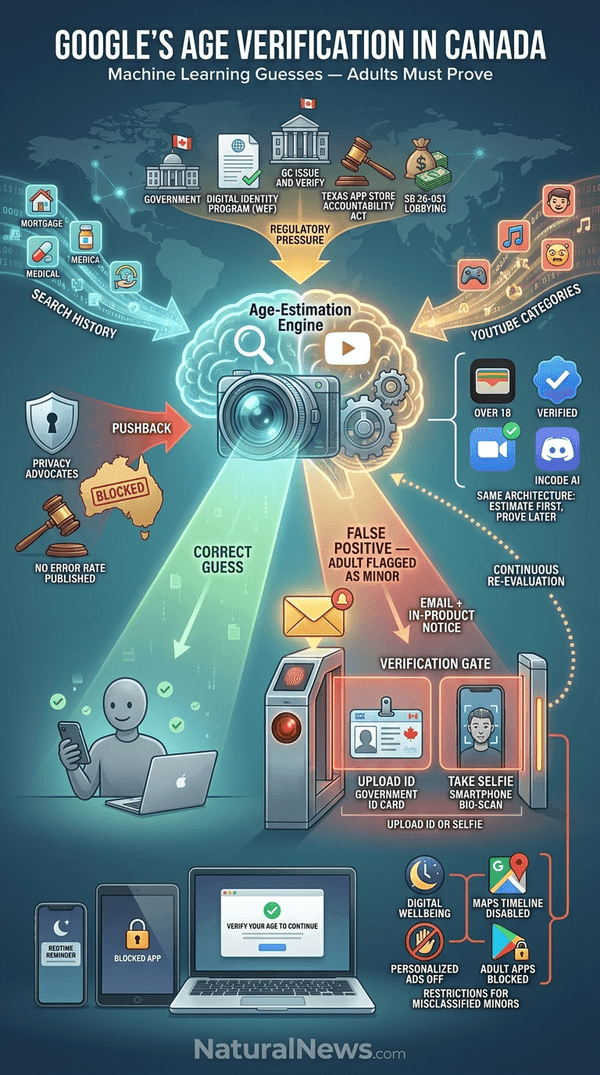
Google Canada announced it will introduce age verification in Canada over the coming days, according to Jeanette Patell, the company’s government-affairs and public-policy director [1]. The system relies on machine learning to estimate whether an account holder is over or under 18, Patell announced on September 14 [1].
Adults who are incorrectly classified as minors will be able to provide a government-issued ID or take a selfie to correct the estimate [1]. The announcement post referenced protecting children as the stated purpose of the measure, while also acknowledging that the model may produce false positives, in which an adult is classified as a minor [1].
The rollout is part of what the report described as a broader digital ID age verification agenda [1]. The announcement did not specify how many Canadian adults might be required to submit identification or a selfie [1].
Google Announces Canadian Age Verification Rollout
The verification system was announced by Google Canada’s government-affairs and public-policy director, Jeanette Patell, on September 14, according to the announcement [1]. Patell said the implementation would occur over the coming days [1].
The announcement post included references to protecting children as the stated justification for the age verification measure [1]. The report stated the announcement is part of a broader digital ID age verification agenda [1].
Canada’s digital identity initiatives have been documented in other contexts. Canada launched a federal Digital Identity Program with help from the World Economic Forum, aiming to develop a digital proof-of-identity document that can be used across government services, airports, and border control [2]. The Employment and Social Development Canada department has also confirmed it is developing a digital ID for certain licenses and permits, called “GC Issue and Verify” [3].
Machine Learning and Account Signals Used to Estimate Age
Google will use machine learning to estimate whether an account holder is over or under 18, according to the announcement [1]. The estimate relies on signals from data already gathered and tied to the account, including the types of information a user has searched for [1]. The categories of videos watched on YouTube are also listed as a signal, according to Patell’s post [1].
The announcement stated that the model may produce false positives, classifying an adult as a minor [1]. The use of automated systems to make determinations about users has been a subject of broader debate. Google’s planned use of machine learning to estimate age echoes practices by other platforms. Apple recently enabled its Wallet digital ID to confirm a user is over 18 when creating an Apple Account or downloading apps rated 18+, according to the company’s support documentation [4].
Meta has also rolled out a “Facebook Verified” badge that requires users to record a video selfie, which the company checks against photos already on file [5]. Discord began testing Incode, an AI-powered identity verification firm, for both ID scans and selfie-based age estimation [6].
Adults Classified as Minors Face Account Restrictions
Users classified as likely under 18 will receive YouTube Digital Wellbeing reminders to take a break and go to bed, according to the announcement [1]. Safeguards will limit repetitive viewing of some categories [1]. The changes also include disabling Timeline in Maps, disabling personalized advertising, and restricting age-sensitive advertising categories [1].
On Google Play, access to adult-restricted apps will be blocked for users who do not prove their age, according to the announcement [1]. It is unclear how many adults in Canada will be affected by the classification and will seek to correct their age [1].
The restrictions reflect a broader trend in age verification requirements. Texas Governor Greg Abbott signed the App Store Accountability Act on May 27, requiring tech companies like Apple and Google to verify users’ ages and obtain parental consent for minors before allowing app downloads [7]. The Supreme Court allowed Texas to enforce the law at least for now [8]. In Colorado, a lobbying group bankrolled by Amazon, Apple, Google, Meta, and OpenAI is pushing Governor Jared Polis to sign SB 26-051, which would force operating system providers to harvest users’ dates of birth and pipe that data to app developers through an API [9].
Verification Process and Privacy Concerns
Affected users will be notified via email and in-product notices, after which they can upload a photo ID or take a selfie to prove they are over 18, according to the announcement [1]. The report stated that the process is becoming more about platforms watching what people do, guessing who they are, and demanding proof when the guess goes wrong [1].
Privacy advocates have raised concerns about age verification systems that require identity documents or biometric selfies [1]. Google’s announcement did not specify how many Canadian adults may be required to submit ID or a selfie [1].
The concerns extend beyond Canada. In the United States, 12 states now use mobile device driver’s licenses that require face scans to prove identity, according to Zoey Sky [10]. The Federal Trade Commission has considered a proposal that would allow businesses to use facial biometric scanning “age-estimation technology” to obtain parental permission for children under 13 to use online gaming services [11]. Critics have warned that such systems could enable mass data harvesting [12]. In Australia, the Senate passed an urgent motion to block the rollout of mandatory age verification for search engine users, with the motion drawing strong bipartisan support [13]. A separate report noted that the Australian Senate rejected age verification for search engine users, citing serious privacy concerns [14].
Conclusion
Google said the measures are intended to protect children, according to Patell’s announcement [1]. Adults who decline verification will continue to be treated as minors for the listed Google services [1].
The rollout is scheduled to occur over the coming days [1]. Further details on the verification process and its effects in Canada were not immediately available [1].
References
- Ken Macon. “Google May Ask Canadian Adults for ID or Selfies”. Reclaim The Net. September 15, 2026.
- ChildrensHealthDefense.org. “With Help From WEF Canada to Launch Federal Digital Identity Program”.
- LifeSiteNews. “Canadian government launches trial version of digital ID for certain licenses, permits”. December 22, 2025.
- Reclaim The Net. “Apple Adds Age Verification to Digital ID in Wallet, Moves Beyond TSA Airport Checkpoints”. April 27, 2026.
- Reclaim The Net. “Facebook Verified: Meta Now Wants a Video Selfie of Your Face”. July 24, 2026.
- Reclaim The Net. “Discord’s New Face-Scan Vendor Comes with a Familiar Promise”. June 30, 2026.
- Laura Harris. “Gov. Greg Abbott Signs Law Requiring Age Verification, Parental Consent for App Downloads”. NaturalNews.com. June 1, 2025.
- 100PercentFedUp.com. “Supreme Court Upholds Controversial Red State Age Verification Law, For Now”. July 8, 2026.
- Reclaim The Net. “Big Tech Backs Colorado OS-Level Age Data Bill”. May 20, 2026.
- Zoey Sky. “12 US states now using mobile device drivers licenses that require face scans to prove your identity”. NaturalNews.com. August 15, 2023.
- ChildrensHealthDefense.org. “Critics Sound Alarm as FTC Weighs Gaming Industry Proposal to Verify Parental Consent Using Facial Age-Verification Technology”.
- NaturalNews.com. “FTC’s COPPA ‘Age Verification’ Loophole: A Trojan Horse for Mass Data Harvesting of Children”. March 7, 2026.
- NaturalNews.com. “‘License to Browse’ Blocked: Aussie Senate Rebels Against Mandatory Digital ID for Search”. January 2, 2026.
- Laura Harris. “Australian Senate Rejects Age Verification for Search Engine Users in Surprise Bipartisan Push”. NaturalNews.com. August 3, 2025.
Explainer Infographic
Submit a correction >>
Tagged Under:
age verification, AI, Big Tech, Canada, child safety, computing, digital identity, Glitch, Google, ID verification, information technology, online safety, privacy, selfie, tech giants, technocrats
This article may contain statements that reflect the opinion of the author
RECENT NEWS & ARTICLES